

2024 Budget - An Analytical Overview
- Insights Digest
- Oct 31, 2024
- 3 min read

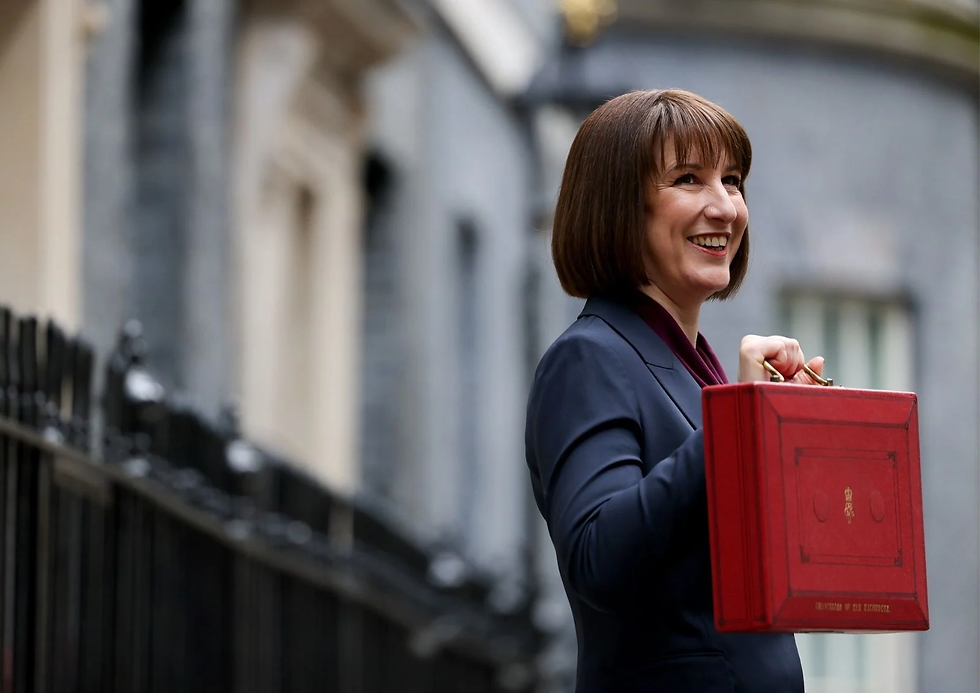
Institution of Civil Engineers, 2024
Jake Smith - 31/10/2024
Following the recent budget, it is clear that the main rationale is to balance public finances, seeing over £40 billion in tax rises. The following points are the impacts from the Budget Announcement we saw yesterday:
The proposed tax rises would not hurt ‘working people’.
Employers National Insurance Contributions to be increased by 1.2 percentage points from April 2025.
This means a new rate of 15% with a lower earnings threshold of £5,000 from £9,100 will take place until April 2028, which will then move in line with CPI afterwards.
Capital Gains Tax to rise from 10% to 18% on reduced rate, and 20% to 24% on higher rate.
Stamp Duty Land tax increased from 3% to 5% on additional dwellings as of 31st October.
Carried interest to rise from 28% to 32% in April 2025
Applying standard rate to private schooling and boarding school services from 1st January 2025.
Private schools to be removed from charitable rate relief from 1st April 2025.
Current ISA limits and Child Trust Fund limits to be maintained until 2030
Reform of non-domicile system to a residence-based system
Removing 50% discount on foreign income in 2025-26
It’s currently speculated what the residence-based system will be, although tax experts predict the 4-year FIG regime is most likely.
Temporary Repatriation Facility - The regime will last for 3 years from April 2025. For the first 2 years, the rate is 12%, which increases to 15% in the final year.
Agricultural Property Relief / Business Property Relief Relief Reform
First £1 million of agricultural and business assets per estate to be Inheritance Tax (IHT) free
Assets over £1 million receive a relief of 50%, indicative of an effective tax rate of 20%, whereas IHT didn’t apply before.
Alternative Investment Markets shares taxed at 20% IHT rate.
Energy Profits Levy to be increased from 35% - 38%, levy extended until 2030.
Investment allowance of 29% removed
Consumer Goods Changes
Company Car Tax - set ‘appropriate’ percentages for ICE’s, hybrids, and electric vehicles for 2028-29, and 2029-30
Increase passenger duty from 2026-27, and a further 50% increase for private jets
Vaping - Introduce a flat rate duty of £2.20 per 10ml from October 2026
Tobacco duty - introduce an accelerator (RPI + 2%) and increase duty (RPI + 10%) for hand-rolling from October 2024.
Soft drinks industry levy - Uprate by CPI since introduction in 2018, uprate annually by CPI from April 2025.
Market Response
UK bond prices tumbled as a result of the second-biggest proposal of government bond issuance on record (£297 billion). Whilst this was only slightly higher than projections, investors predict an additional £142 billion in borrowing over 5 years. The OBR regards Wednesday’s budget as “one of the loosest on record”. 2-year yields jumped to 4.51%, 18 basis points; the highest level since May. 10-year yields lie at 4.5% (as of 31st October), the highest level in nearly a year. According to swap pricing, the market now only favours three quarter-point cuts by the end of 2025, compared with five on Friday. According to strategist Evelyne Gomez-Liechti at Mizuho International, investors are anxious about inflationary pressures arising from the budget, how loose it is, and the extent to which it can influence BOE’s reaction to cutting rates. Despite the uptick in Gilt yields, this is still a fraction of Liz Truss’ mini-budget, whereby there was a 100-basis-point rise in three days. The sell-off in gilts contaminated other UK assets. The pound first reduced to its weakest since August, and stocks diminished. Financials Firm Goldman Sachs (GS) with heavy UK exposure declined by 2.7%. Yield-sensitive sectors, such as REITs, retail, and utilities, were adversely impacted.
Chief European Strategist at Jefferies, Mohit Kumar, believes the immediate concern for fiscal sustainability would be expansion funded by long-dated issuance. However, Jessica Pulay, executive of UK’s Debt Management Office, assures that “investors will be able to absorb gilt supply over the coming years”. According to strategist Evelyne Gomez-Liechti at Mizuho International, investors are anxious about inflationary pressures arising from the budget, how loose it is, and the extent to which it can influence BOE’s reaction to cutting rates. Strategist at RBC, Megum Muhic, maintains this “is not a healthy re-pricing in gilts”. The market doesn’t seem to be convinced whether the spending measures will drive growth in the UK, coupled with elevated Gilt sales, and thus the recent budget announcement still holds significant uncertainty.
HM Treasury. (2024) Autumn Budget 2024. Available at: https://www.gov.uk/government/publications/autumn-budget-2024 (Accessed: 28 October 2024).
Institute for Fiscal Studies. (2024) Autumn Budget 2024: Initial IFS Response. Available at: https://ifs.org.uk/articles/autumn-budget-2024-initial-ifs-response (Accessed: 28 October 2024).
HM Treasury. (2024) Policy Costing Document - Autumn Budget 2024. Available at: https://assets.publishing.service.gov.uk/media/6721d2c54da1c0d41942a8d2/Policy_Costing_Document_-_Autumn_Budget_2024.pdf (Accessed: 28 October 2024).


Comments